Port Townsend Brewing

A friend and I hopped on our bikes last month and went on a five day tour, from Seattle to Bainbridge to Port Townsend to Whidbey Island to Anacortes to San Juan. We pedaled along at a fairly leisurely pace but still had time to visit three breweries en route.

Conveniently located at the end of the bike trail into town, the Port Townsend Brewing Company has a tasting room but no kitchen. Which is fine because they have some great beer. There’s a Mexican place just across from them, if you’re hungry. They also sell logo pint glasses, so I got to carry one of those around in my panniers for the rest of the trip. What surprised and delighted me most about this place was that they had four different IPAs on tap. You don’t see that very often.

Port Townsend Brewing

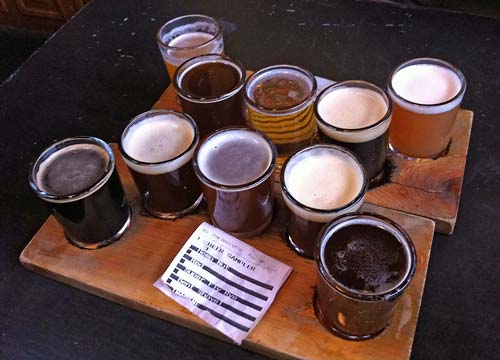
Port Townsend Brewing taster tray – 1 — Port Townsend, WA

    Rob’s Picks

  • Chet’s Gold – slight hoppy edge, refreshing, goes down easy. Good for a hot day.
  • Bitter End IPA – good! Decent hoppiness, citrusy. My fave of the four IPAs.
  • Hop Diggidy IPA – little crisper than the Bitter End, floral
  • Strait Stout – a touch on the light side, but a good all-around stout
  • Peeping Peater Scotch Ale – smoky, really nice
  • Imperial IPA – kinda creamy, nice!
  • Barley Wine – wow. Best barley wine I’ve tried (but I usually don’t like barley wines). 10.5% – extremely dangerous. Usual strong taste reserved for the finish.
    The Rest

  • Pale Ale – ok, but nothing remarkable
  • Reel Amber – ibid
  • Brown Porter – ibid
  • Boatyard Bitter – not bad, but kind of blah
  • Single Hop IPA – spicy edge, not an intense hoppiness. My least favorite of the four IPAs.

Snoqualmie Falls

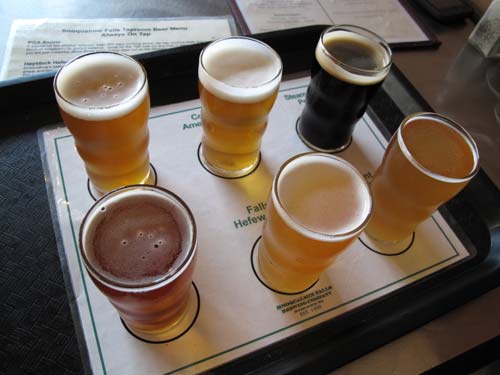
I’d been meaning to check out the Snoqualmie Falls Brewing Company for years and finally made it there this summer after an afternoon of rock climbing. I forgot to bring along my little Moleskine for jotting down my random beer tasting notes, but fortunately, I had my nifty new iPhone with me and was able to tap them slowly into the Notes app, and then email them to myself. Too bad I didn’t just write this post while I was sitting there tasting their beer rather than two and a half months and four brewpubs later. It hasn’t been a very good summer for keeping on top of things.

Update! September 9, 2011: I stopped by again after a fun bike ride on the Iron Horse Trail from x38 to Snoqualmie Pass. I was pretty thirsty but only had one beer — had to get back to Seattle to see Archers of Loaf play a reunion show.

Snoqualmie Falls Brewing Company

Snoqualmie Falls Brewing Company taster tray — Snoqualmie, WA

    Rob’s Picks

  • Harvest Moon – 5.3% – seasonal – Good complex maltiness. Subtle breadiness on the finish. Not too light, not too heavy. A fine beer.
  • Copperhead American Pale Ale – Quite nice, with a bit of a floral aroma and good hoppiness. I’ll have to try the nitro next time.
  • Steam Train Porter – Strong chocolatey flavor, almost coffee-esque. Slurped thisone right down.
  • Wildcat IPA – Not as crisp as I usually like, but fairly solid.
    The Rest

  • Summer Ale – Pretty good. Drinkable and not as light as I expected (more of a pilsener), but nothing really stood out about it.
  • Haystack Hefeweizen – Okay. Citrusy edge, so no need for a slice of lemon.
  • PGA Amber – Pretty blah. Not much of anything going on with this beer, unfortunately. At first my geek side thought the acronym stood for Pretty Good Amber, which would’ve been a misnomer, but the beer menu had all sorts of golf lingo sprinkled in its description. Oh well.

In case you’re wondering, I’m trying to figure out how these beer posts should look. When I first started them I thought I shouldn’t say anything bad about any given brewery and/or their beers, and so I decided to only mention the beers I liked (or, in one or two cases, disliked the least). Hence, the “Rob’s pick” and “Runner(s)-up” devices. The number of runners-up was my nudge-nudge-wink-wink way of letting you know if I thought the brewery made good beer or not. But yeah, enough of that. Not only is this an inconsequential blog on the internet, but beers I’ve liked and disliked have sometimes been almost complete opposites to the preferences of friends who have been with me, drinking the same beer. So basically, what I scribble here doesn’t really matter, except to me. But if for some reason a brewer is scouring the web looking for some sort of validation, stumbles across my amateurish tasting notes, and gets all depressed and weepy by the opinions of a complete stranger, well, at least they have plenty of beer on hand in which to drown their sorrows. Anyway. I like the “Rob’s pick” thing, but I’m not sure how to incorporate that with a list of all the beers I’ve tried. A paragraph followed by the pick and runners-up? Bulleted lists of the beers I liked and didn’t? Some sort of ranking? Hmm.

Update! January 8, 2011: Well, not too long after this post I decided on what format to use, and now I’m finally digging through my early, sometimes sparse, notes and adding the rest of the beers. You can thank me later.

Boundary Bay

Boundary Bay Brewery and Bistro in Bellingham, WA, is a big place but, on the Friday and Saturday my brother and I went by, very crowded. At least that keeps the beer on tap fresh, right? Maybe. I did the sampler tray, and the biggest disappointment was the Scotch Ale, which was flat. Ugh. I hope it was just a bad batch. The rest, fortunately, were fair to very good.

    Rob’s Picks

  • Inside Passage Ale – not so crisp but great hoppiness
  • Bellingham Blonde – tasty, with a nice hoppy edge
  • Imperial Oatmeal Stout – 8.5%! Very strong, maybe a bit too strong. Dangerous, perhaps. For advanced beer drinkers only…
    The Rest

  • Best Bitter ESB – fine and well-rounded, but not a whole lot of character. Could be hoppier. Great beginner beer, though.
  • Amber – okay, but also kind of unremarkable. Goes down easy, though. Another great beginner beer.
  • Scotch Ale – good caramel flavor, but pretty flat. With just a little carbonation it would have been really good.

Progress! Only one more microbrewery post until I’m all caught up, and then I’ll have to start hitting some new ones. There are six or seven nearby that I haven’t visited yet…

Chuckanut Brewery

I visited my brother in Bellingham back in July, and we hit the Chuckanut and Boundary Bay brewpubs. Both are nice spots, but Chuckanut was smaller and more relaxed than Boundary Bay. I took pictures of the sampler trays at the time, but, unfortunately, those pictures are now gone. I could take photos of their logo glasses here in my apartment, but it’s just not the same. Sigh. Larry and I each ordered a sampler tray at Chuckanut Brewery and Kitchen, and we each had different favorites. There were three organic and three non-organic (inorganic?) beers represented. Contrary to my usual green side, I liked the three non-organics better. Ah well.

    Rob’s Picks

  • Shwarzbier – mmm, just right
  • Pilsner – good hoppiness, light
  • Helles Lager – good all-around lager, very drinkable
    The Rest

  • Organic Golden Ale – very bubbly, a bit too apple-y, kinda big for a golden
  • Organic British IPA – okay, decent hoppiness but not so crisp
  • Organic Amber – “clean, smooth” – yup. Not the most interesting, though.

Más cerveza, por favor

The South American brewpost continues…

Baguales – Puerto Natales, Chile
Fairly new microbrewery. They do two beers, a rubia and a negra, but I was only able to try the rubia — the restaurants with their beer on tap were unfortunately out of the negra. The rubia was quite nice, though, and went down very well after nine days hiking around Torres del Paine national park. Wasn’t able to visit the cerveceria, however. One guy said that they’re still brewing in their house, or something like that. Maybe someday they’ll move into a more tour-friendly facility. Nice logo glasses for sale at the pizza place on the main square. This glass was the one whose base broke en route to Seattle. Someday I’d like to go back and get a replacement, and try the negra…

Austral – Punta Arenas, Chile
My only cerveceria tour. It’s a pretty big facility, and calling it a microbrewery is kind of like calling Red Hook a microbrewery, but oh well. I think their two original beers are now brewed further north, but this, the so-called southern-most brewery in the world (the Argentine town of Ushuaia is further south and has three microbreweries), is still in full operation and makes new, special batches. Because I did the full brewery tour and tasting, I was (relatively) more thorough in my note-taking, so I’ll pass it all along.

The originals:

  • Lager – light, crisp, clean finish. A good lager.
  • Polar Imperial – heavier lager, sort of between a lager and an amber. Okay.

The new brews:

  • Patagona Pale Ale – really quite good, my favorite of the Austral brews
  • Calafate – a fruit beer, made with the local calafate berry (somewhat juniper berry-ish). It’s not a sweet berry, and, refreshingly, it’s not a sweet fruit beer. It has a juniper/calafate aroma, and it just might be my favorite fruit beer (which isn’t saying much because I don’t really like fruit beers, but still, I liked this one).
  • Yagan Dark – okay. Not sweet, at least.

Beagle – Ushuaia, Argentina
I tried Beagle’s Fuegian Stout (negra fuerte). It tasted a little strong (and it is, 7.8%), but it was good. Reminded me of Pyramid’s Snow Cap, actually. I ended up spending way too much time trying to buy a Beagle glass, but couldn’t find one for sale. There were two restaurants that had them but they were unwilling to sell, and I’m not so much into pint glass stealing. Ah well. I did find two other Ushuaia microbrews in the process, though.

Cape Horn – Ushuaia, Argentina
The one glass I was able to buy in Ushuaia was for Cape Horn Brewing. I tried their Pale Ale, and it was okay, but nothing great.

Haín – Ushuaia, Argentina
I tried the Haín Roja and wasn’t sure what to make of it. It’s an interesting beer. Faint pineapple-y aroma. Decent bitterness, but the flavor was not something I’m used to. It’s one of those beers you sip and think about, and after a while I think you become a fervent believer in. I didn’t quite reach that level with just the one.

El Bolsón Cerveceria – El Bolsón, Argentina
Those of you keeping score at home will notice that I have eight breweries listed in this post, but I mentioned previously that I had seven to go. This one is the extra. I thought about leaving it out because the pint of rubia I had in Buenos Aires wasn’t so good, with a subtle green olive flavor, but I decided to include it as a bit of advice for those traveling to Argentina: If you want to try the El Bolsón Cerveceria beers, don’t try them in Buenos Aires — go to El Bolsón and try them there.

Ted’s Beers – Sucre, Bolivia
I tried both of Ted’s Beers during my stay in Sucre. The Ámbar isn’t quite the amber I’m used to, with its hint of apple, but it wasn’t bad. The Chala also wasn’t bad and had a light, slight citrus edge. Not sure which I would drink more of, if I ever end up in Sucre again.

Lucho’s Beer – Huaráz, Perú
Lucho serves his beer in his bar, 13 Buhos, located above another bar and near the Cruz del Sur office. Nice guy. The beer is made from the four traditional ingredients, plus coca leaves for an extra kick. The roja was interesting, not quite sweet, and had a high alcohol content edge to its flavor. It was okay, but I much prefered the negra. That had a spicy/bubbly start, then mellowed to a decent-to-good dark beer taste. Sort of a light stout or heavy porter. Aside from the Antares Stouts, Lucho’s negra was my favorite South American dark beer.

And now it’s time to move on. In the two months since I’ve been back, I’ve visited three Washington brewpubs. I need to get those written up at some point. A blogger’s work is never done…

Cervezas de Sudamérica

Well, I was off traveling in South America for a while, and in addition to seeing all sorts of amazing things, I also managed to sample a few cervezas. The microbrews there can be a little hard to find sometimes, but they’re around, and I’m happy to say I discovered quite a few. I’ve been putting off writing my little summary of South American microbrews, however, because it’s going to be a long post. So, I guess I’d better get started. I’ll kick it off with a picture of the logo beer glasses I acquired on my way down through Patagonia:
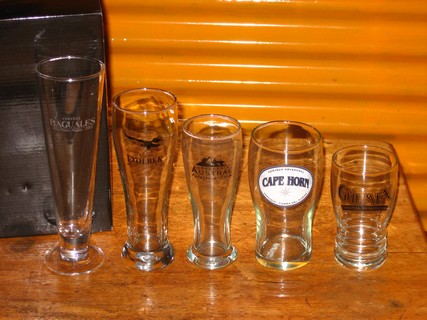
vasos

A sampler of Patagonian beer glasses

Now, I don’t normally travel around with glassware in my backpack, but it did make for a somewhat entertaining story at the hostels. I could actually manage to carry four of them in my daypack without too much trouble, but five was just too many, and that was when I shipped them home. I took the picture before packing them up in case they got all smashed to bits en route. Surprisingly, four of them made it intact. The Baguales glass (the tallest one) suffered a broken base, but I was able to superglue it back together. It’s not pretty, but it stands and holds beer, and I can live with that. Next time I’ll let my friends buy the glasses in other countries and bring them back to me as souvenirs.

Entonces, la cerveza. A few things first, though. South America seems to like their dark beers on the sweet side, which I don’t. There were a few exceptions, but for the most part I was sadly disappointed with the dark beer selection. As a corollary to the sweet rule, bitterness was very hard to find — so, no IPAs.

Some terminology:

  • Rubia = blonde. This applied to any light beer, pretty much.
  • Trigo = wheat. Self-explanatory.
  • Roja = red. Mostly self-explanatory, but applied to pale ales and ambers as well as reds.
  • Negra = black. Stouts and porters.

In general, the rojas were the best.

Antares – Mar del Plata, Argentina
The brewery is in Mar del Plata, but they have alehouses in Mendoza and Bariloche, as well as a few other spots. This was my first decent microbrew after six weeks of mass-produced lagers, and that may have contributed to my liking it so much. At first I felt a little guilty about drinking beer in Mendoza, but I did drink my fair share of wine there, too, thus assuaging that pesky guilt. Of course, the very first place I mention violates the “no IPA” rule, but only occasionally. They have a seasonal IPA which wasn’t being produced when I was there, but they did have a good seasonal Trigo. Their cream stout was also good, and I think I also liked their porter. Their Scotch Ale was a wee bit watery, if I remember correctly. Unfortunately, I didn’t take notes on the Antares beers I drank, for some reason. But in general, they brew a good beer, and after so long away from my beloved pacific northwest beers it was a big ol’ draft of nostalgia.

Otto Tipp Brewpub – El Bolsón, Argentina
I was all set to like this place, but was a bit disappointed. The Trigo was oddly sweet, with a bit of a lemony taste. Not so good. The Roja was better, but it was warm — they had just run out of the cold stuff. I think I tried a sip of the Rubia, but it didn’t make much of an impression. Never got to try their Negra.

D’Olbek – Coyhaique, Chile
I stumbled upon this local beer by accident in an Italian restaurant in Coyhaique. As far as I can tell, they only have the one brew, Rubiaike, and it’s very good, very tasty. If you find yourself in Coyhaique, it’s definitely worth your time to try this beer. The restaurant served it in a D’Olbek glass, and that’s when my collector’s OCD kicked in — I bought the glass from them for 3000 Chilean pesos (about $5) para mi colección. It was all downhill from there.

El Chaltén Brewpub – El Chaltén, Argentina
This was one of my favorite spots in El Chaltén, even though it was a bit too crowded. Good beer and tasty food. They brew a bock and a rubia, but when I was there, they were out of the bock. And, in fact, on my last night in town they were out of both. It was sad to see big bottles of Quilmes being served. Anyway, the rubia is good. Wish I could’ve tried the bock. Apparently the owner/brewer was away on vacation for a month and didn’t quite brew enough to span the gap. At least I was able to try the rubia. It was going to be two weeks before their beer would be back on tap.

Gülmen – Viedma, Argentina
I never made it to Gülmen’s home town of Viedma, but I did try three of their beers. The rubia and roja (Dorada Patagónica and Roja Pale Ale, respectively) I found to be, for lack of a better word, meh. Nothing interesting, not bad, not good — meh. The Negra Porter was okay. All in all, I wasn’t too impressed with their beers.

Supay – El Chaltén, Argentina
The tiny town of El Chaltén apparently has two cervecerias, the second being Supay. I tried their negra at a wine and beer store the night the El Chaltén Brewpub was serving Quilmes, and, well, it was better than the Gülmen, but not great. The only place I saw Supay on offer (in bottles) was this store (I’ve forgotten the name), located on the street Lago del Desierto, near Avenida MM De Güemes. The shop has a fine selection of Argentine beers.

Jerome – Potrerillos, Argentina
This little brewery is located near Mendoza, but I tried their Roja in the El Chaltén beer and wine store mentioned above. It was pretty good, not overly sweet like some other breweries. Nice little kick at 6% alcohol, too. I saw Jerome (pronounced as in English, not Spanish) on offer in El Calafate. Surprised I didn’t see it in Mendoza. Next time I’m there I’ll have to look harder, but, then again, they’ve got the Antares alehouse.

Otro Mundo – San Carlos Sud, Argentina
I have the feeling beer in Argentina doesn’t travel particularly well. The Otro Mundo brewery is in Santa Fe, north of Buenos Aires, and I tried two of their beers way down south in El Calafate. The Nut Brown Ale was almost good, but it had that same annoying sweetness that so many South American dark beers have. It was a sad moment, indeed, because it had been a long time since my last nut brown ale, and the Otro Mundo bottle looked good, and I was looking forward to it. Alas. But then I had a bottle of their Strong Red Ale (7.5% alcohol — Roja Fuerte!), and, I have to say, it was the WORST craft beer I’ve ever had. It had an incredibly strong aroma, taste, and aftertase, of green olives. Horrible. Green olive beer? Even thinking back on it is making me nauseous. But. I have to give the Strong Red a little slack because, as I stated earlier, I have the feeling beer in Argentina doesn’t travel particularly well. I met an Irish couple later on who loved Otro Mundo’s Strong Red, and they’d tried it in Buenos Aires. So, that old adage comes to mind: Think globally, drink locally. If you try the Otro Mundo, better to try it close to Santa Fe. Not in El Calafate.

Whew! Eight down, seven to go. This is taking a long time — I’m going to have to split this up into two posts. Stay tuned.
21st Amendment

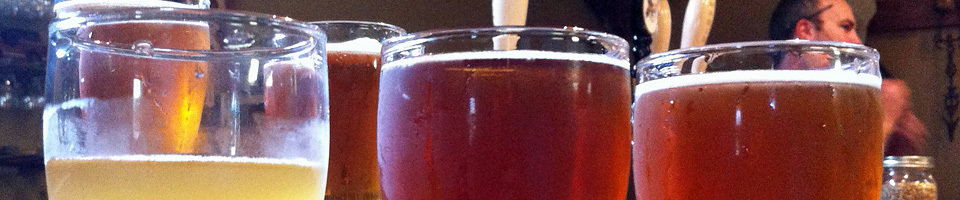
I ended up in the Bay Area recently, but only managed to get to one brewpub, 21st Amendment. Pretty cool spot, but the taster set was the most expensive one I’ve had: $14! Could’ve saved $2 if I had asked them to hold the taster of the guest cider on tap, but oh well. Had a “half” salad, as well, that turned out to be huge — a thick mound on a full-size plate. I don’t think I want to know how big the “full” size is. Anyway. They have an odd mix of beers. Can’t say I recommend their banana beer, and I didn’t try their IPA because it only comes in cans (as does their watermelon beer). Hmm.

21st Amendment

Artfully arranged 21st Amendment samplers — San Francisco, CA

    Rob’s Picks

  • Back in Black – one of those dark IPAs. Not so crisp but dark and hoppy, which is nice. 7.2%
  • South Park Blonde – nice, drinkable, fairly light. 5.1%
    The Rest

  • Autumn Wheat – okay, slight sweet edge
  • Fat Bavarian – banana wheat. Banana/clove flavor too strong for me.
  • Bitter American – American extra pale ale – bitter in a bad way. Basically a bad IPA, although it did start to grow on me by the end. Hmm. Only 3.8%, sadly.
  • Holiday Spice (seasonal) – winter pumpkin ale – ugh. At least it was strong. 7%

Calapooia

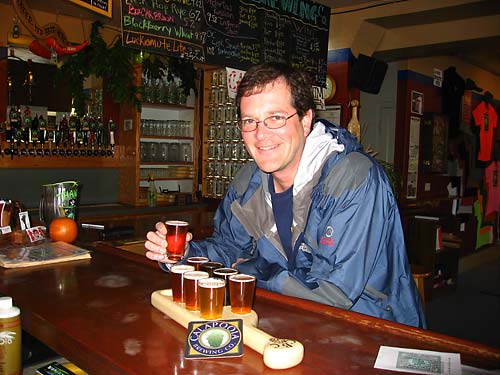
I liked Calapooia Brewing. Some of their beer was pretty light and they all seemed filtered, but after the previous few beer-soaked days, it was a pleasant change of pace. If they have their seasonal Fresh Hop Rye on tap, you should definitely get that.

Calapooia

Enjoying the fine beverages of Calapooia Brewing — Albany, OR

    Rob’s Picks

  • Devil’s Hole Stout – really nice
  • Box Car Brown – really nice
  • Riverdog ESB – crisp, good
  • Fresh Hop Rye – really nice
  • Big Aft Pale Ale – “Big” in name only. Light, but nice. Original name was “Big Ass.”
    The Rest

  • White Water Wheat – very light
  • SantiAmber Ale – light, but decent
  • Tugboat IPA – not too crisp or hoppy, but pleasant

Oregon Trail

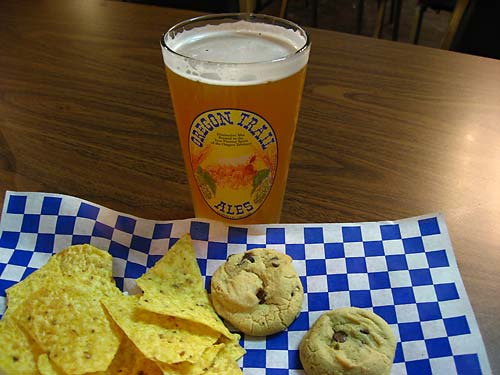
The Oregon Trail Brewery is in an odd location. It’s tucked into a corner of the Old World Deli, which has all sorts of old European facades inside to give you the feeling that you’ve stepped into a 19th century European village. Unfortunately, the cheap, cafeteria-style tables and chairs detract from the feeling. The little deli in the back has the Oregon Trail beer on tap, but they don’t have any formal taster trays. One of the women working there improvised with those little plastic salsa containers, though, and she gave me some complimentary chips to go along with the pint I eventually ordered. Did a brewery tour, which was fun. They’ve crammed a lot into their small but vertical footprint — the rooms aren’t particularly big, but they have three floors and have incorporated gravity into the beer-making process. Fun. Also got to try their Hopdoctor, a hopped-up version of the Beaver Tail, and it was really good.

Oregon Trail

Oregon Trail: the Old World Deli refreshment — Corvallis, OR

    Rob’s Picks

  • Wit – very drinkable, really nice balance
  • Brown Ale – very drinkable
  • Beaver Tail Kolsch – very drinkable
    The Rest

  • IPA – hoppy and crisp, but more on the soapy than citrusy side
  • Ginseng Porter – odd but okay. Ginseng flavor not too overpowering, but brewer said they were dialing it down a bit.

Block 15

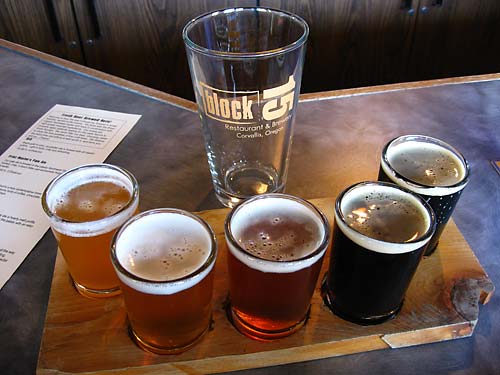
Block 15 had 13 beers on tap, but the taster tray was limited to five. Probably for the best because a lot of their beers had pretty high alcohol content. Not that that’s a bad thing. Since this was the first brewpub after the beer blogging suggestion, the pictures will start here.

Update!  November 30, 2011: During a recent stay in Corvallis, I re-visited the burgeoning Block 15 beer empire. In addition to their brewpub, they have now opened a European-style gastropub next door called Les Caves. It is European-style presumably because they serve a whole lot of bottled European beers (in addition to two Les Caves-only Block 15 beers) and the food’s much fancier than in the brewpub. Ended up tasting eleven more of their beers. Yikes! Good thing it was spread out over two days. The difference between the old and the new tasting notes are pretty noticeable…

Block 15

Block 15 sampler block and logo glass (original photo) — Corvallis, OR

    Rob’s Picks

  • Caves IPA – 6% – Good floral aroma. Very strong hoppiness — nice floral/citrus blend. Full malty base with slight caramel flavor. Big, strong IPA.
  • Caves Saison – 5.5% – Has that banana aroma and flavor, but the flavor was well-balanced by maltiness and strong hoppiness. Quite smooth, too. Kappy didn’t taste the banana, so maybe it’ll come off as clove if that’s your thing.
  • Strawberry Fields – 7% – Sour kick to strawberry flavor. Interesting, especially the aroma: sour creaminess, kind of cheese-like.
  • Imagine – 15% – “Bourbon barrel Belgian Imperial Stout” — Holy cow! Strong bourbon aroma. Bourbon stout explosion to a chocolate finish. Thick and strong. A huge beer! Wow. They only sell this every other year, apparently — I wish I’d bought a bottle or six…
  • Bent Shovel – 10% – Alcohol aroma. Great caramel/alcohol balance. Bitter finish.
  • Hemp Nut Brown – 5% – Fun tangy flavor to the nut brown. Interesting bitter aftertaste, slightly floral. Not light, not heavy, but elements of both. Second hemp beer I’ve seen, and I’ve liked both. Hmm…
  • Alpha IPA – hoppy and crisp, kinda citrusy. Yum!
  • Print Master’s Pale Ale – quite nice, very drinkable
  • Aboriginale – Big! Like this better than Print Master’s, actually. 7.1%!
    The Rest

  • Glo, Golden Lager – 5% – Fairly bubbly. Bready start balances the lightness. Lemony finish.
  • Apricot Ale – Apricot aroma. Strong tangy apricot flavor that lingers.
  • Ridgeback Red – 6.3% – Floral aroma and flavor. Strong hoppiness. Okay.
  • Super Fly Rye – 7.5% – Floral aroma. Pretty hoppy, but in the same floral way. Some maltiness, but not too much. Lingering bitterness.
  • Dunkel Weissbier – 5.5% – Alcohol aroma. Interesting alcohol/hop/malt balance, but a little watery.
  • Chocolate Porter – very chocolatey, maybe too much so. Slight licorice edge to aroma and flavor. Finishes with root beer flavor. Kappy sez, “Tastes like Chocolate Red Vines.”
  • Nebula Oatmeal Stout – kinda weak, but at 6.8% it won’t take much to do the trick
Block 15 redux

Visit #2 = 2 sampler blocks — Corvallis, OR

  • Recent Posts

  • Categories

  • Archives

  • Enter your email address to receive notifications of new posts via email.